Free shipping in Sweden on purchases over 299 SEK


Why Does My Car Smell Stuffy? The Most Common Causes Explained

Why Does My Car Smell Stuffy? The Most Common Causes Explained
You open the car door on a grey morning. A heavy, slightly damp smell hits you immediately — one that has no place in the cabin you want to step into. In fact, this is one of the most common complaints among drivers. The cause, however, is rarely a single obvious culprit. The real answer almost always lies in a combination of trapped moisture and stagnant air. Textiles that absorb everything from everyday life also play a role. In addition, a ventilation system that is quietly struggling makes things worse. Understanding the source is the only way to actually fix it. Ultimately, that knowledge is what allows you to enjoy a cabin that smells as refined as it should.
Why Your Car Smells Stuffy After Rain or Cold Weather
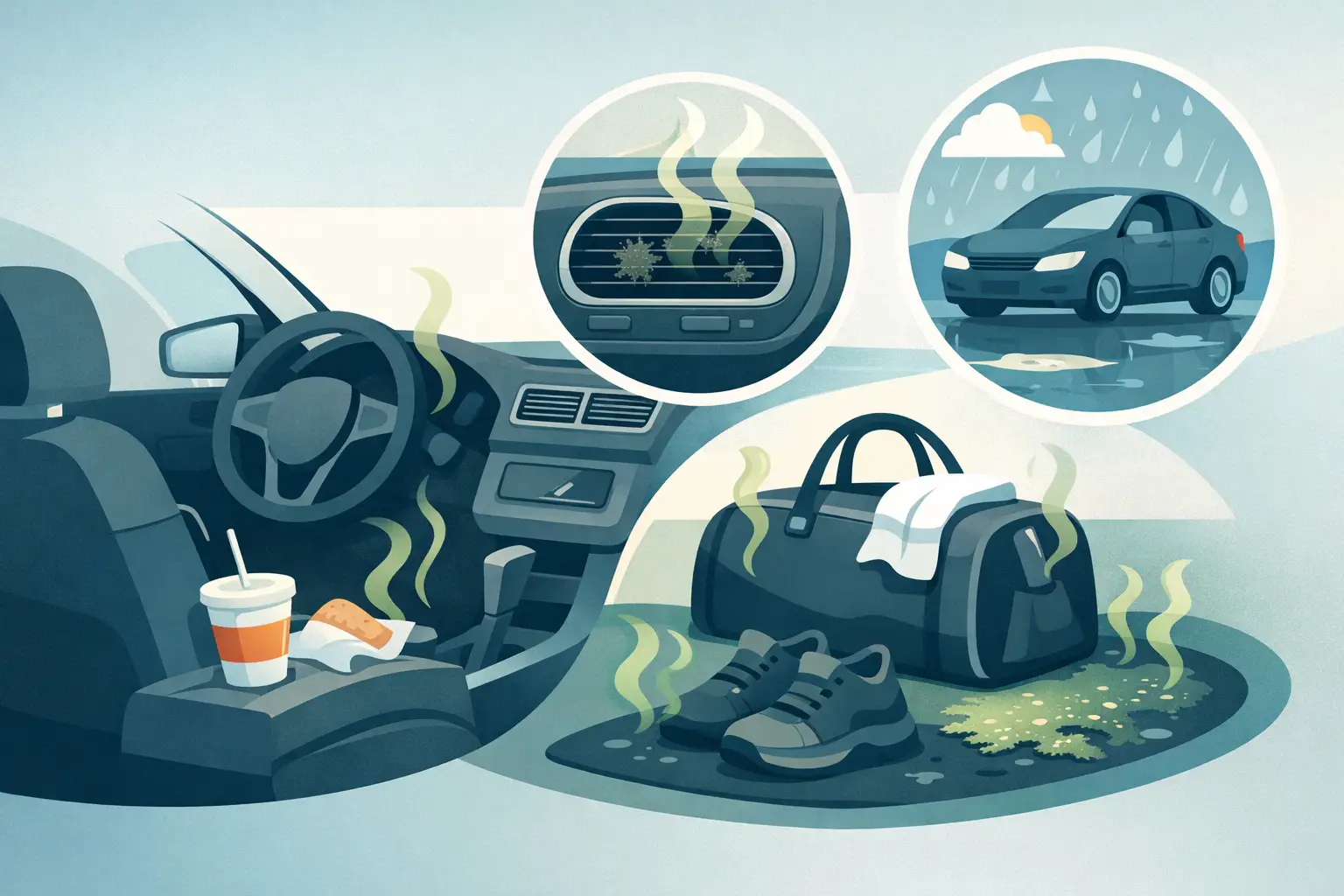
Moisture is, above all, the most common reason a car develops a stale or stuffy smell. However, we are not talking about obvious flooding — rather the subtle, persistent dampness that creeps in through wet shoes, umbrellas dripping onto floor mats, snow tracked in during winter, or a door seal that no longer closes perfectly. Once moisture settles into fabric mats, seat upholstery or foam insulation, that characteristic musty feeling builds quickly.
Many drivers notice the smell most sharply after rain or during autumn and winter. The cabin simply does not have enough time to dry out properly between journeys. Furthermore, if the car is used primarily for short trips, the ventilation system never gets warm enough to push humidity out effectively. Consequently, moisture accumulates layer by layer, day by day, until the smell becomes impossible to ignore.
There is also an important nuance worth knowing. A car can feel completely dry to the touch and still harbour hidden moisture under rubber mats or deep inside the ventilation ducts. Therefore, a quick vacuum and a few minutes of open windows rarely solves the problem at its root.
The Most Common Causes of a Stuffy Car Interior
A clogged or aging cabin air filter is one of the first things to check when a car smells stuffy. The filter captures dust, fine particles and moisture from the air circulating through your HVAC system. When it becomes saturated or simply old, airflow weakens and the air itself starts to smell tired and stale. In particular, if switching on the fan makes the odour stronger rather than better, the filter is a strong suspect. Replacing it is one of the simplest improvements you can make — and it often delivers a bigger difference than most drivers expect.
Floor mats and fabric surfaces are another major contributor. Rubber mats are practical, but if water pools on them for extended periods, the moisture spreads outward. Fabric mats, boot liners and cloth seats, meanwhile, absorb everything from daily life — a spilled coffee, damp gym kit, or a forgotten bag left overnight. Similarly, if the smell intensifies after the car has been closed up for several hours, the textiles are almost certainly involved. The odour settles into the fibres and concentrates in the stagnant air around them.
The air conditioning system deserves attention as well. As the AC runs, it naturally produces condensation. In some cases, bacteria or residue builds up inside the system, resulting in a damp, slightly sour smell — sometimes edging toward mildew — that appears the moment the fan starts. This does not always signal a serious fault, but it does indicate the system needs servicing. Unfortunately, this is also the smell that many drivers try to cover with fragrance rather than address directly. As a result, the underlying issue remains, and no amount of perfume will truly eliminate it. For a deeper understanding of what separates genuine car perfume from a simple cover-up, see our guide on the difference between car perfume and air freshener.
Everyday items brought into the car contribute more than most people realise. Sports bags, takeaway food, damp jackets, pet accessories and reusable shopping bags all leave olfactory traces. Because a car is a small, enclosed space with limited airflow when parked, these smells do not dissipate the way they would in a larger room. Instead, they linger, layer on top of each other, and gradually create that unmistakable stuffy atmosphere.
How to Tackle a Stuffy Car Smell at the Source
The most effective approach is always to identify and remove the source rather than simply masking it. Therefore, start with a thorough clean — remove all mats and vacuum every surface including under the seats. Check for any hidden damp spots in the boot or under floor coverings. If fabric surfaces have absorbed moisture or odours, a proper textile cleaner will do far more good than a temporary spray.
Replace the cabin air filter if it has not been changed recently. This single step can transform the quality of air circulating through the cabin. In addition, consider having the air conditioning system professionally cleaned or treated with a specialist antibacterial spray if the musty smell appears only when the fan runs.
Ventilation habits also matter. Whenever possible, leave windows slightly open when parked in a safe location to allow airflow. Running the fan on a warm setting for the last few minutes of a journey helps dry out any residual moisture in the system. Similarly, removing wet items from the car promptly rather than leaving them overnight prevents moisture from settling into upholstery.
Once you have addressed the underlying causes, the cabin is finally ready for something more intentional — a genuine fragrance experience rather than a cover-up. A high-quality car perfume diffuses scent evenly and continuously, transforming every drive rather than simply fighting unpleasant odours. If you are unsure where to start, our guide to long-lasting car perfume walks you through exactly how to choose the right one for your driving style and cabin size.
When Fragrance Belongs in the Car — and How to Choose Well
There is a meaningful difference between using fragrance to hide a problem and using it to elevate an already clean space. Once the root causes of a stuffy car smell have been resolved, scent becomes a genuinely powerful tool. Moreover, the right fragrance does not just smell pleasant — it sets a mood, signals refinement, and makes every journey feel more considered.
Choosing the right format matters as much as choosing the right scent. For example, diffuser-style car perfumes release fragrance gradually and consistently, which suits daily commuters well. Scented cards, on the other hand, offer a more subtle, lingering presence — ideal for those who prefer something understated. Our overview of car scent cards explains how to choose the right feeling for your cabin.
IMAO Parfums designs every fragrance around a travel destination — a specific place, a particular quality of light and air, a memory of arrival. As a result, the scent in your car becomes more than freshness. It becomes atmosphere. Explore the full range at our shop and find the destination that suits your drive.